"Manage your paper-chain": DMS for Logistics and Supply Chain
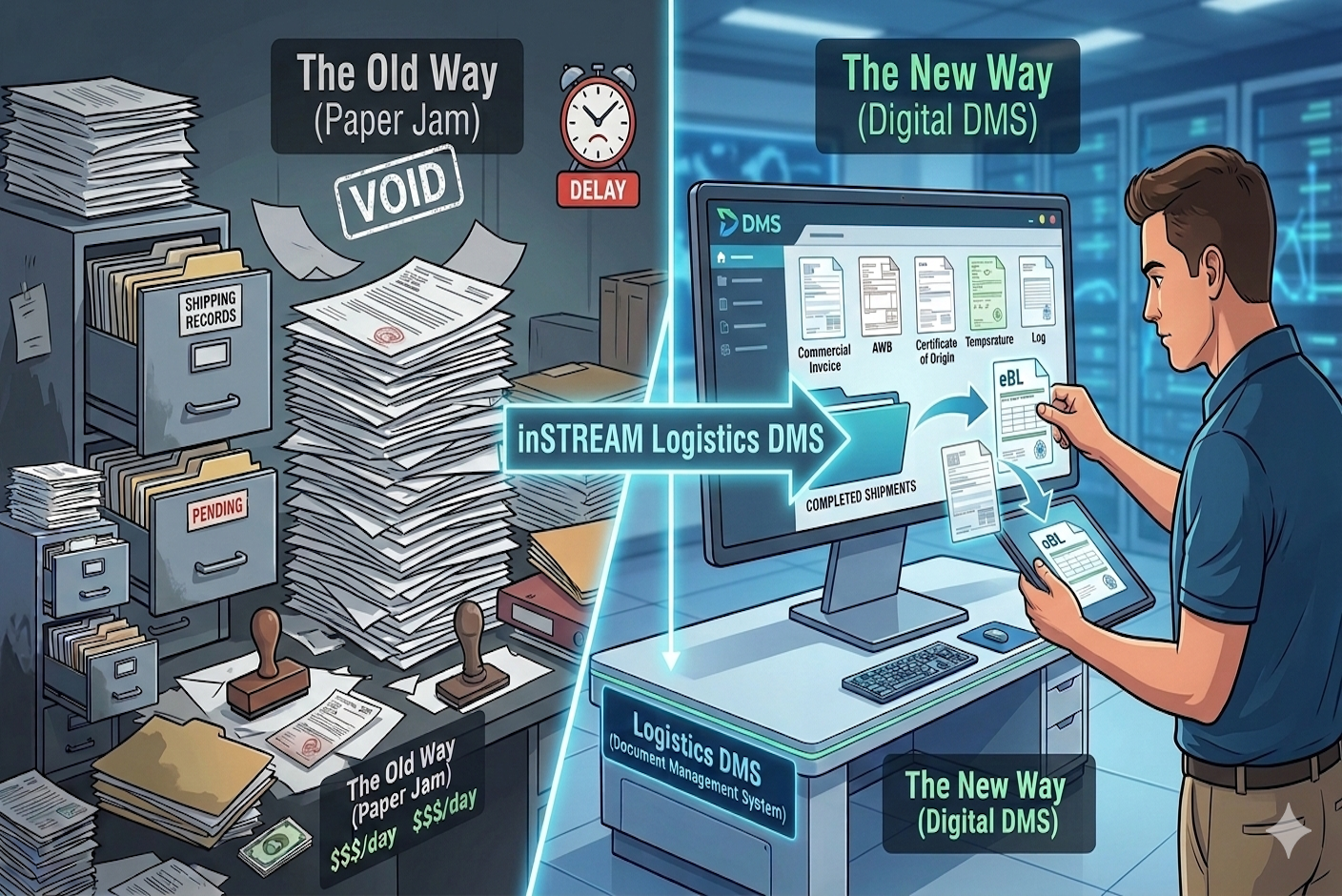
The key issue here is the ability to handle volume, efficiently. To give some idea, global ocean container shipments alone amounted to some 800 million TEU (standard 20 ft units) moved in 2022 (Market Data Forecast 2025). Some 250 million Air Way Bills are generated each year by IATA members and if we include cross-border road and rail transportation we are talking about billions of trade related freight movements annually.
It’s easy to see how much record keeping this generates. A minimum document set for cross-border trade includes an invoice, packing List, BL/AWB and a customs declaration. A manufacturing process might require further documents such as hazardous goods whilst a food and beverages business might require up to 80-100 document types covering sanitary/phytosanitary certificates, certificates of analysis (COA), temperature logs, proof of insurance, certificates of origin to name but some. To manage this volume of documents requires specialist help in the form of a Logistics Document Management System (DMS).
That’s billions of documents and that’s before we consider the impact of change! Global supply chains are highly integrated meaning that geopolitical change has an immediate and practical effect. This could mean a change in compliance documentation arising from changes in trade policy such as tariffs or a whole scale re-routing of ships, planes, trains and trucks due to war or political instability resulting in entirely new document sets.
So, what might we be looking for in our Logistics DMS?
- The ability to securely store huge volumes of digital documents
- The ability to quickly retrieve documents for a shipment – understanding the linkage between documents for a shipment
- The ability for all parties to onboard documents, easily and efficiently
- The ability to classify document by type – understanding which might be time critical or mandatory at each stage of the journey
- The ability to distinguish between common and unique documents for deliveries within a shipment
- The ability to present the record of documents for a shipment to all interested parties including customer, broker, carrier etc. showing compliance achievement and gaps
- The ability to intelligently notify parties of issues, missing mandatory documents, milestones archived etc.
- The ability to extract information from documents, for example, invoice details
- The ability to automatically match invoices to shipments
- The ability to respond to change ‘mid-flight’
- The ability to dynamically optimise the processes
- The ability to integrate your DMS with your freight and transport systems and those of your partners
- Pay per document onboarded to give yourself flexibility
- A partner who really understands logistics
| “But!” I hear you ask, “Doesn’t the introduction of eBL (Electronic Bill of Lading) and eAWB (Electronic Air Way Bills) reduce the number of documents required”? Well, no! Whilst adoption of eAWB is high, adoption of eBL, the greater part by far of global shipping volume, remains relatively low. This is due to a number of factors, not least, the fragmented nature of the approved eBL networks with interoperability only recently developing, the level of adoption of the eBL networks locally (only 20% of banks globally can support eBL) and the necessity that every party to the transaction have the ability to access the network. This is why the eBL networks support “paper fallback”. And of course, Bill of Lading is just one of many documents as we discussed above! |
The Electronic Trade Documents Act 2023 UK A pivotal moment in the digitising of trade documents. This allows a digital (electronic) Bill of Lading to have the same legal force as the paper Bill of Lading, that is proof of ownership of the cargo at a point in time. The facility now exists to exchange eBL on secure networks. |
What does the DMS deliver to the bottom line?
- A manual process to assemble the packing lists, bill of lading, invoices etc. could take hours v a few seconds via a Logistics DMS. To give you an idea, a 2-hour process across 50 shipments at $30 per hour labour cost would cost some $3000 – a cost that would be pretty much eliminated by deployment of a DMS
- You know where your documents are …. One version of the truth. They are not hanging about in email threads in multiple inboxes and local folders. This reduces the risk of mis-declarations and delays with the associated fines
- If you don’t invoice until you have assembled all the documents for a shipment then you are delaying cash recovery unnecessarily – using a DMS will help you invoice faster!
- Your customers and partners will love the transparency and timeliness of access to documents
- You will have total oversight of the status of document compliance for all shipment plus active management from the platform
- You will have a full audit trail to support your contractual and statutory compliance
If you are involved in freight and logistics for yourself or customers and partners and you want to get paper under control – cut costs, improve service and support compliance, contact Celaton to find out why global leaders in logistics trust inSTREAM Logistics DMS.